• Home
  • Recipes
    • VEGAN
    • VEGETARIAN
    • Asian Inspired
    • Korean
    • Main Entree
    • Appetizer
    • Breakfast/Brunch
    • Drink
    • Recipe Collections
  • Tips and Knowledge
  • About
menu icon
go to homepage
  • Home
  • Recipe Index
  • About
    • Facebook
    • Instagram
    • Pinterest
  • search icon
    Homepage link
    • Home
    • Recipe Index
    • About
    • Facebook
    • Instagram
    • Pinterest
  • ×
    Home » Tips and Knowledge

    How to Mince, Slice, and Cut an Onion (Step-by-Step Guide)

    Published Apr 7, 2021 · Updated Aug 14, 2025

    Learn how to mince, slice, dice, and cut an onion with easy step-by-step tips for perfect cuts, less tears, and better cooking results.

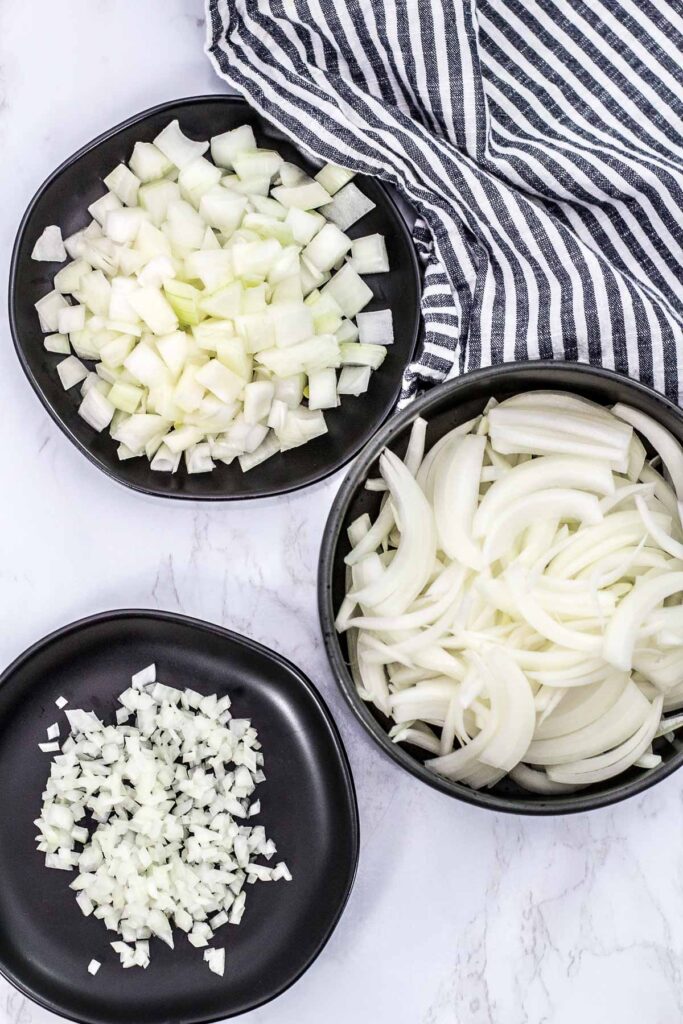
    diced onion on top, sliced onion in the middle, and minced onion on the bottom

    Learning how to mince an onion is just one of several essential knife skills every home cook should know. In this step-by-step guide, I’ll walk you through how to mince, slice, dice, and chop onions so you can tackle any recipe with confidence. You’ll learn easy techniques for even cuts, tips to work faster, and ways to keep tears to a minimum - whether you’re prepping for a weeknight dinner or a holiday feast.

    Jump to:
    • Onion Basics
    • Tools You’ll Need
    • Preparing the Onion
    • How to Chop an Onion
    • How to Dice an Onion
    • How to Mince an Onion
    • How to Slice an Onion
    • Pro Tips for Cutting Onions Without Tears
    • How to Remove Raw Onion Bite
    • Frequently Asked Questions

    Onion Basics

    Choosing the Right Onion

    • Yellow onion: My go-to for cooking, soups, stews, and caramelizing.
    • White onion: Crisp and slightly sharper. Good for salsas and fresh toppings.
    • Red onion: Mostly used in salads, burgers, or pickled.
    • Sweet onion (Vidalia, Walla Walla): Low pungency. Perfect for raw eating or light sautés.

    How to Pick a Fresh Onion

    • Firm and heavy for its size
    • No strong onion smell
    • Dry, papery skin with no sprouts or blemishes

    How to Store Onions

    • Keep whole onions in a cool, dry, dark place
    • Store cut onions in an airtight container in the fridge for up to 7 - 10 days

    Tools You’ll Need

    • Sharp chef’s knife – Essential for clean, even cuts and fewer tears
    • Cutting board – Non-slip or placed on a damp towel for stability
    • Small bowl – To collect minced, sliced, or diced onions as you work
    • Bench scraper – Optional, for transferring onions from board to pan easily

    Preparing the Onion

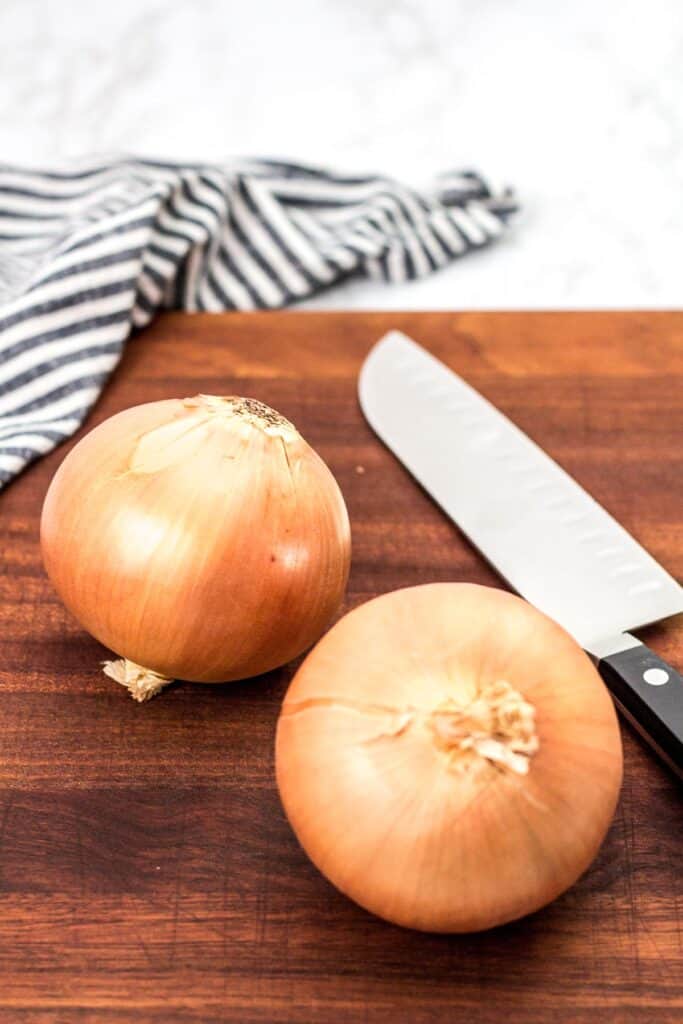
    two large yellow onions on a cutting board with a chef knife
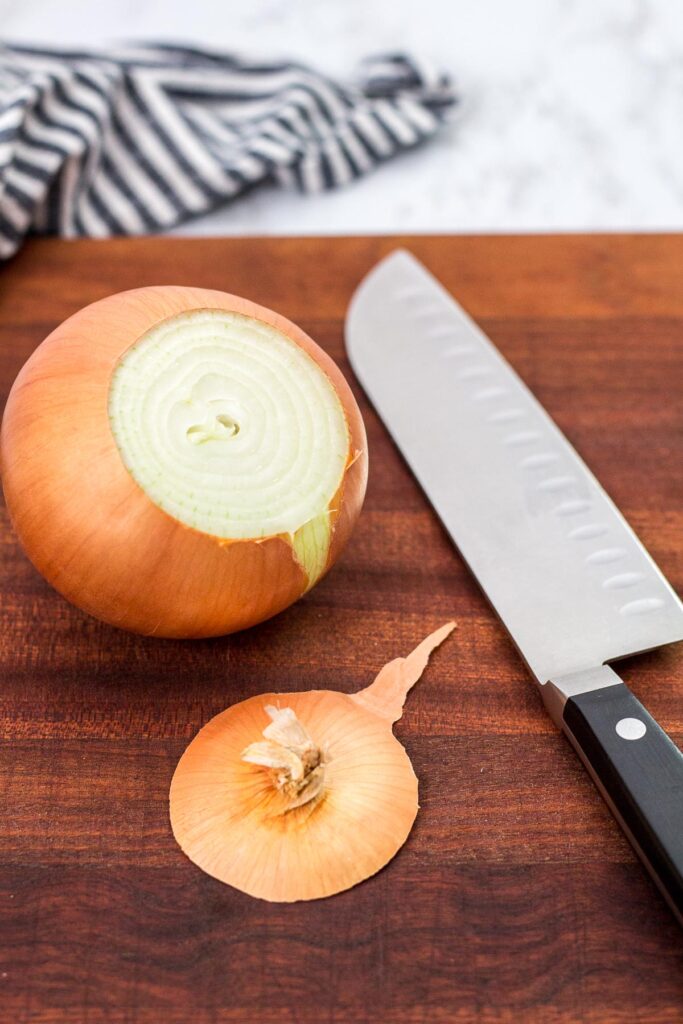
    top part of the onion cut with a knife
    cut the onion in half on a cutting board with a knife
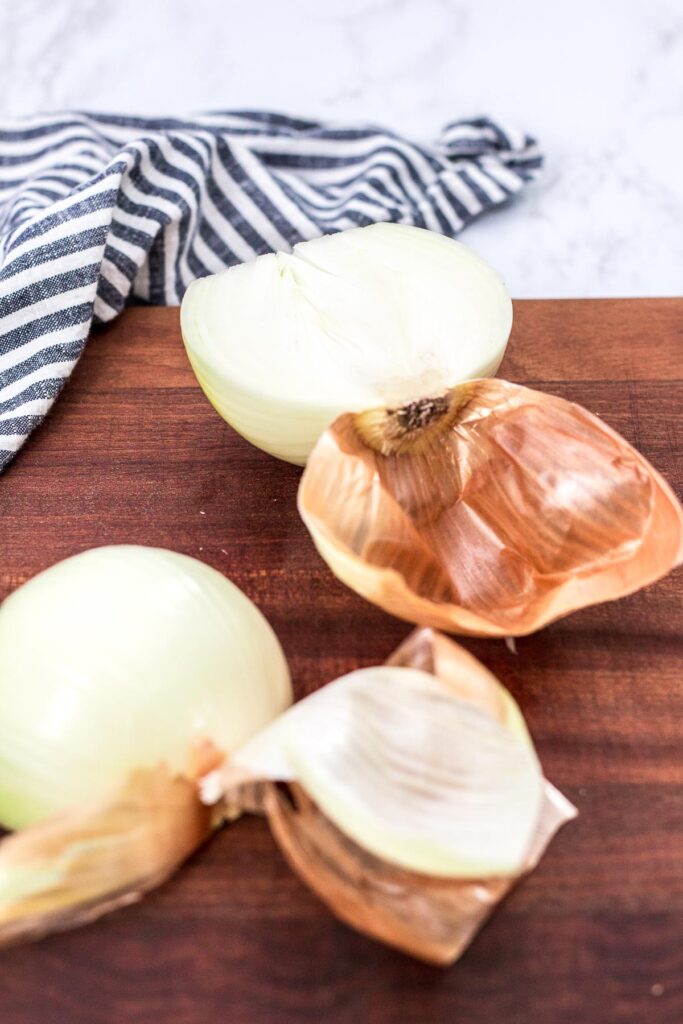
    onion cut in half and outer skin peeled
    1. Trim the neck: Cut off the stem end (opposite the root) but keep the root intact - it helps hold the layers together while cutting.
    2. Halve the onion: Place it cut-side down so it stays stable. Slice in half from neck to root.
    3. Peel the skin: Remove the papery outer layer and discard any tough or bruised flesh.

    How to Chop an Onion

    Chopping is a quick, less precise way to cut onions when uniform size isn’t essential. It’s great for rustic dishes where the onions will cook down.

    1. Prepare the onion: Halve and peel, keeping the root intact.
    2. Slice vertically: Make several cuts from neck to root, spaced according to how large you want the pieces.
    3. Chop across: Cut downward across the vertical slices to create rough chunks.
    4. Finish near the root: Turn the onion so the root faces upward and lies flat on the cutting board. Chop around the root, then discard it.

    Chopping is faster than dicing or mincing, but the pieces will vary in size, making it perfect for rustic soups, stews, roasted vegetables, casseroles, and other slow-cooked dishes where precision doesn't matter.

    How to Dice an Onion

    Dicing is one of the most useful onion-cutting skills. Once you learn it, you can easily adjust the size of your dice (larger cuts for hearty stews, smaller cuts for sauces) simply by changing how close together you make your cuts.

    direct shot of half an onion cut parallel to the cutting board
    straight shot of half an onion sliced parallel and perpendicular to the cutting board
    1. Prepare the onion: Halve the peeled onion through the root. Place one half cut-side down, root end facing away from you.
    2. Make horizontal cuts: Holding the onion firmly, make 2–3 horizontal slices parallel to the cutting board, stopping just before the root so the onion stays intact.
    3. Make vertical cuts: Slice from neck to root, keeping cuts evenly spaced, and stop just short of the root.
    4. Chop across: Starting at the neck end, chop downward across the previous cuts. Continue until you reach the root end, then chop around it.
    5. Finish near the root: When you’re close to the root, turn the onion so the root faces upward and lies flat on the cutting board. Dice around the root into the desired size, then discard the root.
    diced onion on a cutting board
    how to dice the beard part of an onion

    Diced onion is great for soups, stews, chilis, pasta sauces, curries, breakfast hashes, and stir-fries where uniform pieces help everything cook evenly.

    How to Mince an Onion

    Mincing is just a finer version of dicing. You’ll use the same basic technique, but with closer cuts for much smaller pieces. This method gives the most uniform results and is worth learning as a core knife skill.

    1. Prepare the onion: Halve the peeled onion through the root. Place one half cut-side down, root end facing away from you.
    2. Make horizontal cuts: Holding the onion firmly, make 4–6 horizontal slices parallel to the cutting board, spaced very close together, and stop just before the root. The closer the cuts, the finer the mince.
    3. Make vertical cuts: Slice from neck to root, keeping cuts very close together for a fine mince, and stop just short of the root.
    4. Chop across: Starting at the neck end, chop downward across the previous cuts.
    5. Finish near the root: When you’re close to the root, turn the onion so the root faces upward and lies flat on the cutting board. Mince around the root into the desired size, then discard the root.
    6. Refine (optional): Run your knife through the pile again for an even finer texture.

    Alternative method: Some people find it easier to mince by slicing pole-to-pole first, fanning out the slices, and then chopping across. This is quicker but usually less uniform. Once you’re more confident with your knife skills, the standard method will produce better results. It takes some time to learn, but with practice, it will eventually become faster than the alternative method.

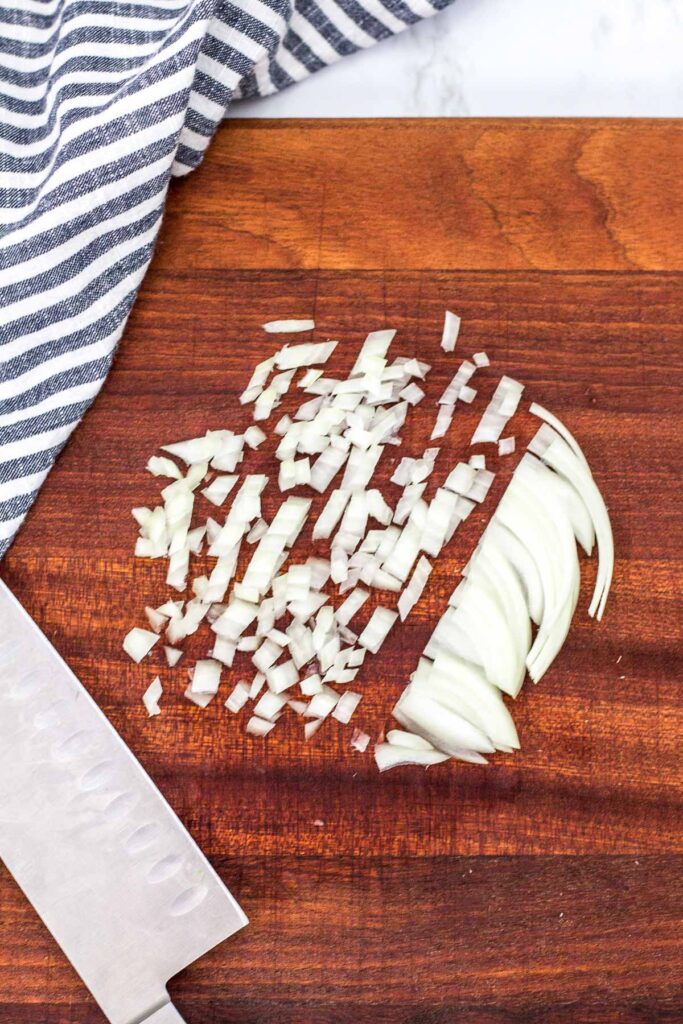
    very thinly sliced onion ready to be minced
    Minced onion on a wooden cutting board

    Minced onion works well in fresh salsa, guacamole, tuna salad, chickpea salad, salad dressings, and sauces where you want the flavor without large chunks.

    How to Slice an Onion

    Slicing is perfect for recipes where you want long strips of onion, either raw or cooked. The method you choose affects how the pieces look and cook.

    sliced onion comparison - sliced parallel to the poles on the left, sliced pole to pole on the right

    Crosswise (against the grain):

    • Produces round rings or half-moons.
    • Best for raw uses like burgers, sandwiches, and pickled onions.
    • Pieces can vary in size, which can cause uneven cooking.

    Pole-to-pole (with the grain):

    • Produces more uniform slices that cook evenly.
    • My go-to method for sautés, stir-fries, and roasted dishes.

    How to slice pole-to-pole:

    straight shot of onion sliced
    straight shot of sliced onion from the bread part of the onion side
    sliced onion on a cutting board
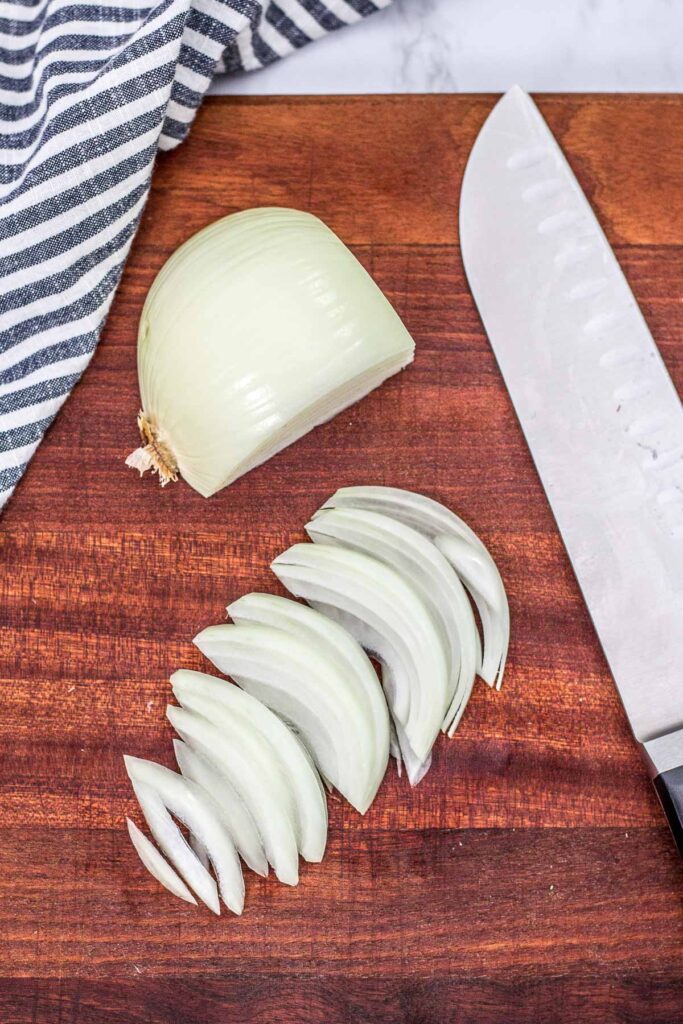
    overhead shot of sliced onion, the beard part of the onion removed
    1. Prepare the onion: Halve and peel, keeping the root intact.
    2. Angle the knife: Start near the root and slice at a slight angle toward the center.
    3. Work around the onion: Continue slicing until you reach the other side.
    4. Remove the root: Cut it off once slicing is done.

    Tip: If you prefer, you can slice straight down instead of at an angle, then trim any larger pieces into thinner strips. Keeping the root attached while slicing helps hold the layers together.

    Sliced onion is perfect for Korean pancakes, noodle dishes like Pad Thai and Japchae, gyros, and pizza toppings, whether used raw or cooked.

    Pro Tips for Cutting Onions Without Tears

    • Use a sharp knife: Cleaner cuts release fewer irritants.
    • Chill the onion: Refrigerate for 30 minutes (or freeze for 10–15 minutes) before cutting to slow the release of tear-causing compounds. This works for me every time.
    • Work quickly: The less time the onion is exposed, the less it will sting your eyes. When I first started cooking, I cried through every onion, which is one of the reasons I was determined to get better at my knife skills.
    • Work near a flame or in a well-ventilated space: Some cooks swear by this trick. I personally couldn’t tell much difference, but it might work for you.

    How to Remove Raw Onion Bite

    • Warm water rinse: Run the onion under warm tap water for 20–30 seconds. I learned this tip from The Food Lab book, and I find it more effective than soaking in ice water. It softens the pungent bite without affecting the onion’s crispness.
    • Toss with acid: If the onion will be used in a salad dressing or marinade, mix it with any acidic ingredient (like vinegar or lemon juice) first. Let it sit a little bit before adding the rest of the ingredients.

    Frequently Asked Questions

    What’s the difference between chopping, dicing, and mincing?

    Chopping – Rough, irregular cuts; fastest method.
    Dicing – Uniform pieces; more precise than chopping.
    Mincing – Very small, fine cuts; most precise.

    What is the best knife for cutting onions?

    A sharp chef’s knife works best for most cuts because it’s sturdy and versatile. A paring knife can be handy for very small onions like pearl onions, but I always use a chef’s knife since it gives me cleaner, more even cuts.

    Can I freeze chopped onions?

    Yes, you can freeze raw onions! Chop or slice them as you would for a recipe, spread in a single layer on a baking sheet, and freeze for about an hour. Transfer to a freezer bag, pressing out as much air as possible before sealing. Frozen onions are best for cooked dishes like soups, stews, sautés, and casseroles, as they lose their crisp texture once thawed. Cook them directly from frozen (no need to thaw).

    How do I store leftover cut onions?

     A cut onion, wrapped tightly in plastic wrap or stored in an airtight container, will last for about 7 to 10 days in the refrigerator. For the best flavor, use it as soon as possible, as its taste will become stronger over time.

    What is the easiest way to cut onions without crying?

    Use a sharp knife, chill the onion in the fridge (or freezer for 10–15 minutes), and work quickly. Some cooks recommend working near a flame or in a well-ventilated space. These tips are explained in more detail in the Pro Tips for Cutting Onions Without Tears section above.

    How to remove raw onion bite?

    Run the onion under warm tap water for 20–30 seconds (a method I learned from The Food Lab), or toss it with an acidic ingredient like vinegar or lemon juice and let it sit briefly before using. Both methods are covered in detail in the How to Remove Raw Onion Bite section.

    Mastering how to chop, dice, mince, and slice an onion will make you faster, more confident, and more efficient in the kitchen. These skills might feel tricky at first, but with practice, they’ll become second nature and you’ll be able to prep onions for any recipe with ease.

    More Tips and Knowledge

    • Overhead image of Mediterranean pantry staples including olive oil, lemon, Greek yogurt, feta, and kalamata olives with text overlay that reads Mediterranean Pantry Staples Guide
      Mediterranean Ingredients Guide: My Go-To Grocery List
    • Seasoned sushi rice in a bowl with a rice paddle, ready to roll with nori sheets and bamboo mat nearby
      Sushi Rice Recipe – Easy Rice Cooker Method for Perfect Results
    • Collage image featuring Japanese pantry essentials including miso paste, panko breadcrumbs, sushi rice, bonito soup stock, mirin, soy sauce, and sesame oil with text overlay that reads “My Japanese Pantry: 10 Everyday Must-Have Ingredients”
      10 Ingredients I Keep in My Pantry for Japanese-Inspired Recipes
    • Collage of Korean pantry essentials including gochujang, doenjang, soy sauce, sesame oil, and sesame seeds with text overlay reading “How I Stock My Korean Pantry – 10 Everyday Essentials
      How I Stock My Korean Pantry: 10 Everyday Essentials

    Share your thoughts below! Cancel reply

    Your email address will not be published. Required fields are marked *

    Footer

    ↑ back to top

    About

    • About George
    • Privacy Policy

    Stay Connected!

    • Pinterest
    • Instagram
    • Facebook

    Copyright © 2022 My Eclectic Bites